
Orthopedic conditions
- Home
- Orthopedic conditions
Shoulde conditions
The shoulder joint is a highly mobile joint because of its shallow ball-and-socket design. The smooth movement of the joint is largely aided by the presence of the ligaments and tendons around the joint. Since the joint is designed for a number of movements, even a small discrepancy can cause joint pain.
Conditions of the shoulder/elbow
Shoulder :
The shoulder is a shallow ball-and-socket joint that is highly dependent on soft-tissue structures surrounding it, including tendons, ligaments, and muscles-the rotator cuff muscles-to provide for smooth motion and to maintain stability. With large numbers of movements relating to the shoulder, it depends enormously on ligaments and rotator cuff muscles for achieving the optimal synchronization.
Following are the common shoulder disorders:
- Impingement/rotator cuff
- Instability
- Adhesive capsulitis/capsular restriction Our physiotherapists will undertake comprehensive subjective and objective examinations by considering quite a number of factors. These are sporting technique, referred pain, biomechanical, and postural issues.
Elbow :
The elbow is comprised of bones, tendons, and three joints that enable movement of our arm. It is the point of connection of the two bones of the forearm, radius & ulna, and the bone of the upper arm, the humerus. This connection between two vital bones is covered by a layer of thick and shiny articular cartilage that absorbs shock and allows the bones to glide smoothly against one another. Injuries related to the elbow can occur due to overuse or sudden trauma. Keeping the cause aside, the injury brings an excruciating pain and difficulty in performing daily activities.
Common Elbow injuries include:
- Tennis Elbow (aka lateral epicondylitis)
- Golfers Elbow (aka medial Epicondylitis)
- Tendinopathy · Fractures
- Nerve entrapment
- Referred pain
Accurate diagnosis is essential for appropriate management of any elbow pain. Precise assessment and quick treatment will restore the regular functions of elbow and eliminate pain as rapidly as possible.
The physiotherapists in Pune are ready to relieve your pain. All you need to do is contact our representative to book an appointment.
Knee/hip conditions
Knee:
The knee is formed with three parts including tibia, which is shine bone or larger bone of lower part of leg, femur, which is thigh bone or upper leg bone, and patella, which is a kneecap. It is the most vulnerable joint in the body which undergoes a lot of stress in everyday life. Two long leg bones are kept together strongly with muscles, tendons, and ligaments. Each end of the bone is enveloped with a layer of cartilage to absorb the shock and protect the knee. Owing to its most vulnerable nature, knee issues occur with aging and relentless wear & tear of joints.
Common injuries of knee include:
- Knee joint injuries
- Iliot ibial Band Syndrome
- Shin Splints
- Runners’ Knee
- Sprains & tears of soft tissues
- Fractures · Dislocation
- Patellofemoral Syndrome
- Anterior Cruciate Ligament (ACL) Injuries
- Posterior Cruciate Ligament (PCL) Injuries
- Collateral Ligament Injuries
- Meniscal tears
- Tendon tears
In many cases, knee injuries are related to more than a structure in the knee. Pain and swelling are the most common signs of knee injury. However, few knee injuries result in instability, which makes you feel that your knee might be ‘giving way’, ‘catching’, or ‘locking up’.
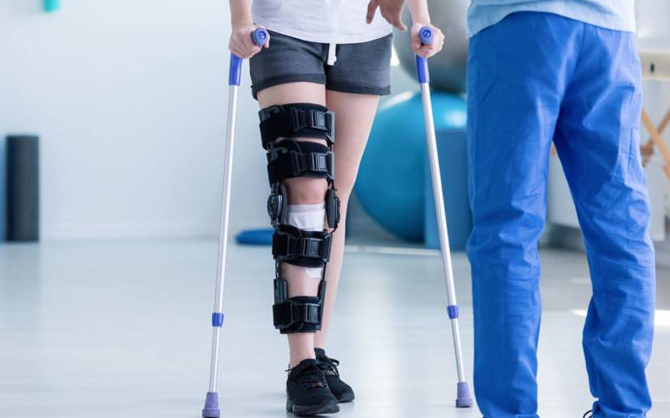
With thorough assessment and rapid treatment from professional and experienced physiotherapists, many knee injuries are treatable by taking simple measures such as bracing and rehabilitation exercises.
Why to search physiotherapist near me when you can directly contact us and book an appointment.